The Facilities Management Landscape Architecture and Site Planning (FM-LASP) team recently completed the Physical Sciences District Framework Plan, a major design plan that aims to resolve long-standing safety concerns, enhance the campus environment, and create dynamic public spaces. We sat down with Mayton Xu, a licensed Landscape Architect (LA) on the FM-LASP team, and lead LA for this project, to learn more about this exciting redesign plan!
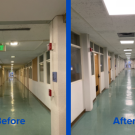
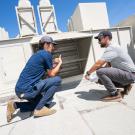
Building Management Services (BMS) is always working on new projects around campus. We sat down with Refik Smlatic, Inspector, Planner, Estimator for Facilities Management (FM) BMS, to delve into the background and details of an impressive project that has led to a complete overhaul of Hoagland Hall’s lighting system and aims to increase campus efficiency as a whole.
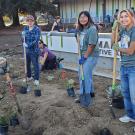
Our campus has long been known for its delightful greenery and natural beauty, but it’s easy to overlook the amount of care and planning that goes into making the UC Davis campus the lush space that it is. Beyond their beauty, campus gardens contribute to sustainability efforts, foster community engagement, and serve as living laboratories for educational exploration. The Gorman Museum of Native American Art, which opened its doors on campus just last year, recently got a garden makeover from Ryan Deering, GATEways Horticulturist, and his Sustainable Horticulture team.
Nearly a decade ago, campus leaders at UC Davis decided to invest in a small team of employees to reduce energy by optimizing building controls and systems. The concept was that UC Davis could fund such a team, if it could curb high utility bills — essentially having the team pay for itself with energy savings.
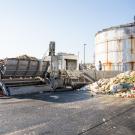
Tucked away on the west side of campus, UC Davis’ READ facility receives 20 tons of food waste per day from customers including local grocery stores and our own campus dining commons. With the improvements a recent $4.77M CalRecycle grant provides, the READ facility becomes an important part of UC Davis’ strategy to eliminate the use of fossil fuels from its operations and fight climate change.
Since taking ownership in 2017, UC Davis Facilities Management has dedicated itself to revitalizing the READ facility, working with academic and industry experts to find creative solutions including the development of an ammonia extraction system that processes the ammonia-rich digestate, separating it into nearly ammonia-free digestate and concentrated ammonia. The ammonia-free digestate can be processed at the campus’s wastewater treatment plant, or by other means, locally without adding excess nutrients to inland waters. The concentrated ammonia product has now become a valuable commodity purchased by California Safe Soil as an ingredient in the formulation of a certified organic fertilizer.